
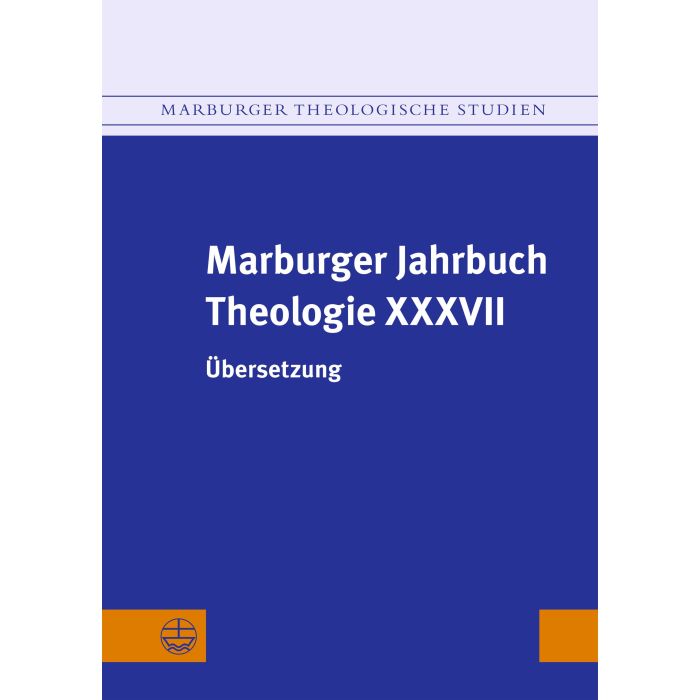
Marburger Jahrbuch Theologie XXXVII
Übersetzung
Übersetzen ist kein Nebenproblem der Theologie, sondern ihr Brennpunkt. Die christliche Theologie kennt keinen unmittelbaren Zugang zu Gott jenseits der Sprache. Gott begegnet in seinem Wort im Zeugnis der Schrift, in geschichtlichen Texten, in menschlichen Worten. Damit ist jede theologische Aussage bereits eine Übersetzung – zwischen Sprachen, Zeiten, Kulturen und Lebenswelten. Übersetzen ist daher mehr als die Übertragung von Bedeutungen. In der Gegenwart, in der maschinelle Übersetzbarkeit und algorithmische Vermittlung den Eindruck erzeugen, Bedeutungen ließen sich verlustfrei transferieren, gewinnt diese Einsicht besondere Dringlichkeit. Die Beiträge in diesem Band – der alttestamentliche von Friedhelm Hartenstein, der kirchengeschichtliche von Peter Gemeinhardt, der systematisch-theologische von Michael Moxter und der praktisch-theologische von Martina Kumlehn – sind dem Anliegen verpflichtet, die Weite, Leistungskraft, das Riskante, aber auch die Grenzen der Aufgabe des Übersetzens zu beleuchten.
Mit Beiträgen von Peter Gemeinhardt, Friedhelm Hartenstein, Martina Kumlehn, Michael Moxter und Notger Slenczka.
[Translation]
Translation is not a secondary issue in theology, but rather its focal point. Christian theology knows no direct access to God beyond language. God is encountered in his word in the testimony of scripture, in historical texts, in human words. Thus, every theological statement is already a translation – between languages, times, cultures, and worlds. Translation is therefore more than the transfer of meanings. In the present day, when machine translation and algorithmic mediation create the impression that meanings can be transferred without loss, this insight takes on particular urgency. The contributions in this volume – the Old Testament contribution by Friedhelm Hartenstein, the church history contribution by Peter Gemeinhardt, the systematic theology contribution by Michael Moxter, and the practical theology contribution by Martina Kumlehn – are committed to illuminating the breadth, power, risks, and limitations of the task of translation.
Mit Beiträgen von Peter Gemeinhardt, Friedhelm Hartenstein, Martina Kumlehn, Michael Moxter und Notger Slenczka.
[Translation]
Translation is not a secondary issue in theology, but rather its focal point. Christian theology knows no direct access to God beyond language. God is encountered in his word in the testimony of scripture, in historical texts, in human words. Thus, every theological statement is already a translation – between languages, times, cultures, and worlds. Translation is therefore more than the transfer of meanings. In the present day, when machine translation and algorithmic mediation create the impression that meanings can be transferred without loss, this insight takes on particular urgency. The contributions in this volume – the Old Testament contribution by Friedhelm Hartenstein, the church history contribution by Peter Gemeinhardt, the systematic theology contribution by Michael Moxter, and the practical theology contribution by Martina Kumlehn – are committed to illuminating the breadth, power, risks, and limitations of the task of translation.
40,10 CHF
Not yet available
Alle Preise inkl. MwSt.
Bestellnummer:
9783374081042
ISBN/EAN:
9783374081042
Verlag:
Evangelische Verlagsanstalt
Produktart:
Buch
Einbandart:
Softcover
Auflage:
1
Sprache:
Deutsch
Reihe:
Marburger Theologische Studien (MThSt)
Band:
146
veröffentlicht:
21.08.2026
Abmessungen:
17 x 24 cm
Vorbestellung
Übersetzen ist kein Nebenproblem der Theologie, sondern ihr Brennpunkt. Die christliche Theologie kennt keinen unmittelbaren Zugang zu Gott jenseits der Sprache. Gott begegnet in seinem Wort im Zeugnis der Schrift, in geschichtlichen Texten, in menschlichen Worten. Damit ist jede theologische Aussage bereits eine Übersetzung – zwischen Sprachen, Zeiten, Kulturen und Lebenswelten. Übersetzen ist daher mehr als die Übertragung von Bedeutungen. In der Gegenwart, in der maschinelle Übersetzbarkeit und algorithmische Vermittlung den Eindruck erzeugen, Bedeutungen ließen sich verlustfrei transferieren, gewinnt diese Einsicht besondere Dringlichkeit. Die Beiträge in diesem Band – der alttestamentliche von Friedhelm Hartenstein, der kirchengeschichtliche von Peter Gemeinhardt, der systematisch-theologische von Michael Moxter und der praktisch-theologische von Martina Kumlehn – sind dem Anliegen verpflichtet, die Weite, Leistungskraft, das Riskante, aber auch die Grenzen der Aufgabe des Übersetzens zu beleuchten.
Mit Beiträgen von Peter Gemeinhardt, Friedhelm Hartenstein, Martina Kumlehn, Michael Moxter und Notger Slenczka.
[Translation]
Translation is not a secondary issue in theology, but rather its focal point. Christian theology knows no direct access to God beyond language. God is encountered in his word in the testimony of scripture, in historical texts, in human words. Thus, every theological statement is already a translation – between languages, times, cultures, and worlds. Translation is therefore more than the transfer of meanings. In the present day, when machine translation and algorithmic mediation create the impression that meanings can be transferred without loss, this insight takes on particular urgency. The contributions in this volume – the Old Testament contribution by Friedhelm Hartenstein, the church history contribution by Peter Gemeinhardt, the systematic theology contribution by Michael Moxter, and the practical theology contribution by Martina Kumlehn – are committed to illuminating the breadth, power, risks, and limitations of the task of translation.
Mit Beiträgen von Peter Gemeinhardt, Friedhelm Hartenstein, Martina Kumlehn, Michael Moxter und Notger Slenczka.
[Translation]
Translation is not a secondary issue in theology, but rather its focal point. Christian theology knows no direct access to God beyond language. God is encountered in his word in the testimony of scripture, in historical texts, in human words. Thus, every theological statement is already a translation – between languages, times, cultures, and worlds. Translation is therefore more than the transfer of meanings. In the present day, when machine translation and algorithmic mediation create the impression that meanings can be transferred without loss, this insight takes on particular urgency. The contributions in this volume – the Old Testament contribution by Friedhelm Hartenstein, the church history contribution by Peter Gemeinhardt, the systematic theology contribution by Michael Moxter, and the practical theology contribution by Martina Kumlehn – are committed to illuminating the breadth, power, risks, and limitations of the task of translation.
Eigene Bewertung schreiben